
Clarke County Court Records After a Jail Arrest
The arrest-to-court path in Clarke County starts with the arresting law-enforcement agency, booking at Northwestern Regional Adult Detention Center if the person remains in custody, magistrate review for bond or commitment, and then court processing. NRADC says the person is taken before a magistrate after arrest. If not released, the inmate is interviewed by pretrial personnel on the next regular court day for arraignment, where a judge reviews bond, counsel, and the next court date.
The Clarke County court-system page identifies the local Circuit Court, General District Court, Juvenile and Domestic Relations Court, and Commonwealth's Attorney channels. General District Court handles most misdemeanors, traffic matters, and felony preliminary hearings. Circuit Court handles felony criminal matters and appeals. Sheriff Travis Sumption's office may be the arresting agency, but the court record belongs to the court system once charges are filed.
Use jail inmate records for custody status, booking process, and NRADC lookup questions. Use jail mugshots for booking-photo access and public-record limits. Court records after a jail arrest focus on the filed case: the charge list, charge level, hearing dates, bond orders, prosecutor action, and disposition.
How to Find Clarke County Court Records After an Arrest
Virginia court portals are the primary online route for adult criminal and traffic case information. General District Court handles most traffic offenses, misdemeanors, and preliminary felony hearings. Circuit Court handles felony criminal matters and appeals. Juvenile and Domestic Relations Court information is restricted online to protect confidentiality.
- Open the Virginia Court System case information hub or the direct General District or Circuit Court case portal.
- Select the Clarke County locality or the relevant court, then search by defendant name, case number, or hearing date.
- Open the case record and compare the filed court charges with any jail booking charges from NRADC.
- Review each charge for code section, offense level, hearing date, bond entry, and current status.
- For older files, sealed matters, or records not visible online, contact the proper clerk rather than relying on the jail roster.
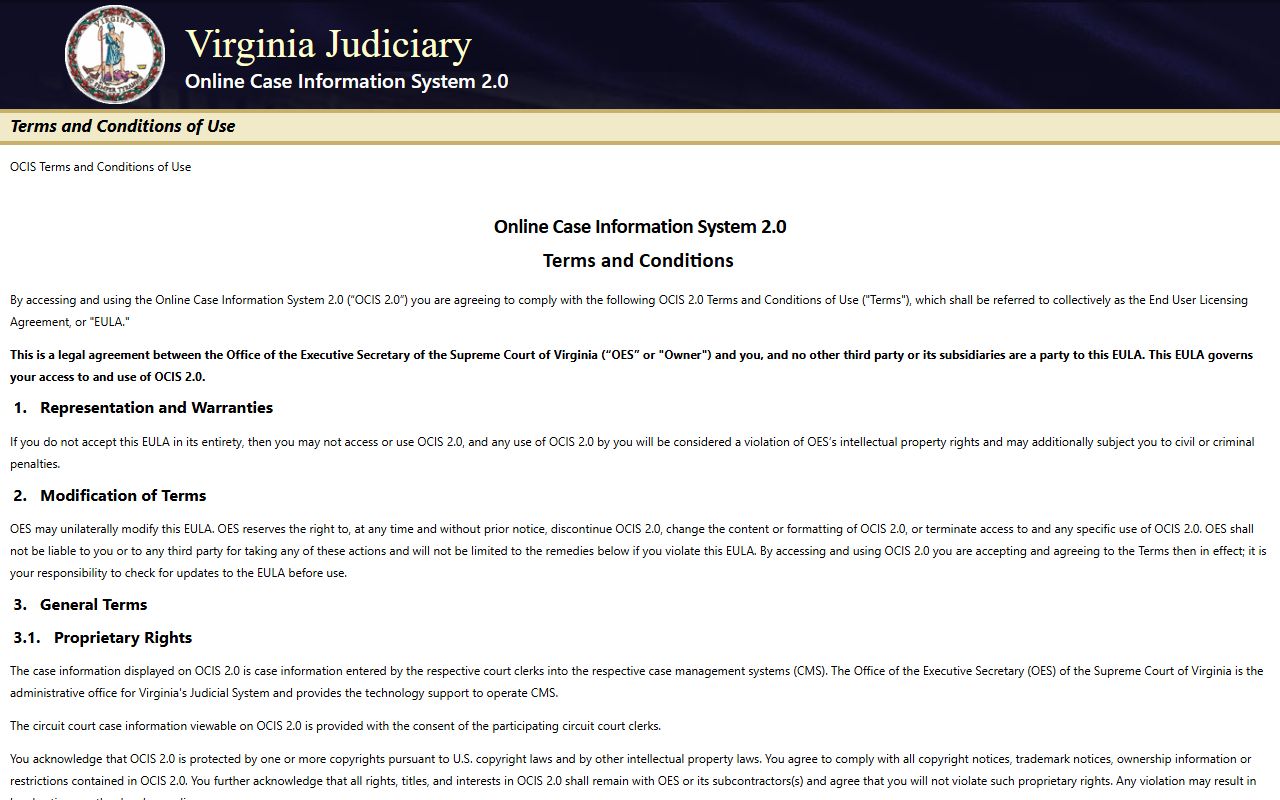
Virginia OCIS 2.0 provides statewide adult criminal case information, but payment and some confidential case categories are outside that public portal.
The Virginia OCIS landing page is the statewide court-search entry for adult criminal case lookups.
How Charges Get Filed After an Arrest
A jail booking may begin with arrest charges and magistrate paperwork. The Commonwealth's Attorney decides how to pursue criminal charges in court, and the court record shows formal filed, amended, reduced, dismissed, nolle prosequi, or disposed charges. Virginia practice does not use the title District Attorney; the local prosecutor is the Commonwealth's Attorney.
| Warrant or Complaint | Information | Indictment | |
|---|---|---|---|
| Filed By | Officer, magistrate, or prosecutor depending on the case path | Prosecutor | Grand jury |
| Common For | Misdemeanors, traffic, and initial felony proceedings | Felony prosecution where allowed | Felonies proceeding in Circuit Court |
| Starts or Moves | Initial court case or charge tracking | Formal prosecution | Circuit Court felony case |
Charge Status in Court Records After an Arrest
Booking charges can change after the prosecutor and court review the case. A jail record may identify the arrest reason, while the court record shows the filed charge and its current status. Check each count separately because one charge can be amended while another remains pending or is dismissed.
| Status | What It Means |
|---|---|
| Pending | The charge is active and has not reached final disposition. |
| Amended or reduced | The filed charge changed, often to a different offense level or statute. |
| Dismissed | The court dismissed that charge, though other charges in the same case may remain. |
| Nolle prosequi | The prosecutor elected not to pursue the charge at that stage. |
| Disposed | The court entered a final result, such as conviction, acquittal, dismissal, or another final order. |
Bond and Release After an Arrest
NRADC's first-48-hours material says bond is initially addressed by the magistrate after arrest. The magistrate decides whether a bond will be issued, what type applies, and whether the person will be committed to the facility if no bond is provided. A judge can revisit bond at arraignment on the next regular court day.
| Bond Type | How It Works |
|---|---|
| Secured | Requires a set amount of money or surety before release. |
| Unsecured | No money is paid upfront, but the person promises to pay if conditions are violated. |
| Personal recognizance | Release based on a promise to appear at the assigned court date and time. |
| No bond or commitment | The person remains in custody unless a later court order changes release status. |
If a bond is provided, cash may be paid to the Magistrate's Office or the Court, and a bonding company may be used. NRADC staff cannot recommend a bail bonding company. A hold, detainer, probation/parole issue, federal hold, or immigration detainer can keep someone in custody even when one charge appears bondable.
Warrants That Lead to an Arrest
No official Clarke County Sheriff's Office active-warrant list or public warrant search was located in the inspected official sources. For non-emergency incidents or deputy messages, use 540-955-1234. For administrative records questions, use 540-955-5152. The sheriff's crime-prevention page describes Winchester-Frederick-Clarke Crime Solvers, which accepts confidential information at 540-665-8477, but that line is for tips, not legal advice about a person's own warrant.
Bench warrants and capiases are often tied to court cases, so search the Virginia court portals and contact the issuing court clerk for case-status questions. A person who believes they may have an active warrant should contact counsel or the relevant court instead of relying on an online public list.
Charges vs. Convictions
An arrest and a filed charge are not the same as a conviction. Court records after an arrest may show accusations, hearings, bond decisions, and later outcomes. A conviction exists only after a plea, verdict, or final adjudication supporting that result.
| Charge | Conviction | |
|---|---|---|
| Stage | Accusation filed in court | Final result after plea, verdict, or adjudication |
| Meaning | Alleged offense, not proof of guilt | Legal finding or admission of guilt |
| Public Record | Often public unless confidential, sealed, or otherwise restricted | Often public unless restricted by law or order |
Sealed vs. Expunged Arrest Records
Virginia FOIA presumes public records are open unless a statutory exemption applies, but court records can be confidential, sealed, or affected by an expungement order. Virginia Code § 2.2-3706 governs law-enforcement and criminal-record disclosure, and court record access is handled through the judiciary and local clerks.
| Sealed or Confidential | Expunged | |
|---|---|---|
| Visibility | Hidden or limited for public access by law or court order | Removed from normal public access under an expungement order |
| Who Handles It | The court or record-holding agency, depending on record type | The court and affected record-holding agencies |
| Eligibility | Depends on case type, confidentiality rule, and order | Depends on Virginia expungement law and the case disposition |
Background Check Considerations
Court case lookups are not the same as FCRA-compliant background checks. Employers, landlords, insurers, lenders, and other regulated users must use legally compliant screening processes and verify records through appropriate official channels.
Important: Do not use casual court or jail lookups for employment, credit, housing, insurance, or other FCRA-covered decisions.
Restricted Court Records After an Arrest in Clarke County
Juvenile and Domestic Relations Court records are limited online because of confidentiality rules. Active investigative material, sealed records, expunged records, and some dismissed or sensitive criminal records may not appear in public portals. For clerk routing, Clarke Circuit Court is at 102 N. Church St., Berryville, with Clerk April Wilkerson at 540-955-5116 or 540-955-5117. Clarke General District Court is at 104 N. Church St., Berryville, with Clerk Julie Aemmer at 540-955-5128. The Commonwealth's Attorney page gives prosecutor and FOIA routing for prosecution-office records.